


Which Anti-Mildew Desiccant Performs Best in Humid Climates for Sea Freight and Storage?
When moisture, heat, and long transit times combine, choosing the right protection becomes critical. Many users ask which anti-mildew desiccant works best in humid climates, especially for sea freight and storage where condensation and mold can quickly damage goods. The answer depends on absorption performance, lasting stability, and compatibility with different materials. This article explores the key factors operators should evaluate to reduce mildew risk and protect products throughout shipping and warehousing.
In practice, there is no single desiccant that performs best for every cargo, every route, and every packaging method. A container of leather shoes moving from Southeast Asia to Northern Europe in monsoon season faces a different moisture profile than bamboo products shipped to the Middle East, or electronics stored in a tropical warehouse with poor ventilation. The real selection question is not simply “which product absorbs the most water,” but “which moisture-control approach still works after temperature swings, repeated condensation cycles, and long dwell times at port.”
That distinction matters because mildew prevention in humid logistics is not only about lowering humidity. Mold develops when enough moisture remains available at the product surface for long enough. A desiccant can remove some moisture from air, but if condensation forms on inner packaging, or if the goods themselves release moisture after loading, mildew can still occur. Operators who only compare nominal absorption percentages often miss the factors that actually decide field performance.
Why humid-climate shipments are harder than standard storage conditions
Humid-climate sea freight creates a more aggressive environment than many users expect. During ocean transit, containers often pass through day-night temperature changes and climate zones. Warm moist air trapped inside the container can condense when the roof or walls cool, creating what logistics teams often call “container rain.” In storage, especially in non-climate-controlled warehouses, a similar process occurs whenever ambient conditions shift faster than the cargo temperature.
Several moisture sources act at the same time:
- Residual moisture in cartons, pallets, fabrics, leather, wood, or foam
- Ambient humid air trapped at the moment of container stuffing
- Moisture migration from cargo during long transit
- Condensation caused by temperature fluctuations
- Secondary moisture entry through damaged or weak packaging
This is why some desiccants look effective in a short bench test but underperform in real routes. Humid logistics is dynamic, not static. The best anti-mildew desiccant for these conditions must continue functioning across cycles of moisture release and condensation, not just initial air drying.
What “best” really means for anti-mildew desiccants
Operators usually judge desiccants by visible outcomes: no mold, no odor, no wet cartons, no stains, and no customer complaints on arrival. To reach that result, a desiccant used in humid climates should be evaluated across five practical dimensions.
1. Absorption capacity under high relative humidity
A desiccant may have good total adsorption under laboratory conditions but respond too slowly in saturated air. In humid-climate freight, relative humidity often remains high for extended periods. Performance at elevated humidity is more relevant than dry-environment capacity figures.
2. Absorption rate
Fast moisture uptake matters when condensation risk spikes suddenly. If the material reacts slowly, free moisture may remain on packaging or product surfaces long enough for mold to start growing.
3. Retention and anti-leak stability
Some desiccant systems can re-release moisture under temperature changes, while others convert absorbed water into a gel or stable phase. For sea freight, retention is often as important as capacity. If water is captured but later released, mildew risk returns.
4. Duration of protection
Storage and shipping schedules rarely follow plan. A cargo expected to move in 28 days may sit for 45 or 60 days because of congestion, customs delays, or destination warehousing. Protection must match realistic logistics time, not ideal transit time.
5. Compatibility with cargo and packaging
A desiccant that works well for footwear cartons may not be ideal for electronics, food-contact-adjacent materials, coated surfaces, or goods sensitive to dust, leakage, or chemical migration. Cargo compatibility should never be treated as a secondary issue.
The main desiccant types used in sea freight and storage
To answer which anti-mildew desiccant works best in humid climates, it helps to distinguish the major technologies operators encounter in the market.
Silica gel
Silica gel is familiar, widely available, and useful in many packaged-goods applications. It performs well in moderate humidity and is often chosen for enclosed unit packaging. Its advantages include cleanliness, low odor, and broad acceptance in many industries.
Its limitation in severe sea-freight conditions is that standard small-pack silica gel is often under-dosed for container-level moisture loads. It can help protect individual boxes or small sealed packages, but it may not control the full container environment effectively unless quantities are carefully engineered.
Clay desiccant
Clay is economical and common in conventional moisture-control packaging. It works reasonably in mild conditions, especially where cost sensitivity is high. However, in very humid climates and long transit cycles, its performance tends to be less competitive than higher-capacity alternatives. It is rarely the first choice when mildew losses are severe.
Calcium chloride-based container desiccants
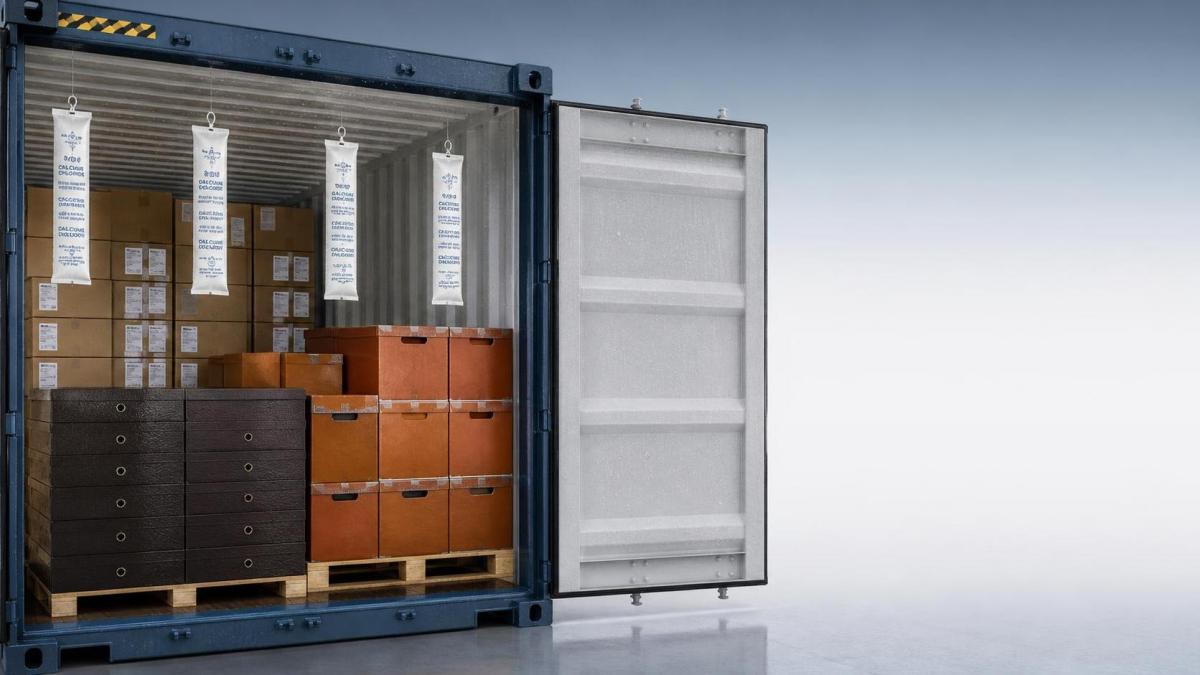
For sea freight in humid climates, calcium chloride-based hanging desiccants or strip desiccants are often among the most effective options at container level. The reason is straightforward: they typically offer strong absorption under high humidity and can capture large amounts of water relative to their starting mass. Many designs also transform absorbed moisture into brine or gel, reducing re-release risk when properly constructed.
This is why these products are frequently used in furniture, garments, footwear, leather, textile, bamboo-wood, and general containerized export cargo. In difficult routes, they often outperform basic silica gel sachets simply because the moisture load is much larger than users first estimate.
Molecular sieve
Molecular sieve has very strong adsorption characteristics in low-humidity environments and in applications requiring deep drying. It is valuable in certain industrial and electronics applications, but for general anti-mildew protection in large humid containers, it is not always the most cost-effective choice. Its value is highest where very low residual moisture is required in tightly controlled packaging rather than in bulk freight airspaces.
Composite anti-mildew systems
Some logistics protection programs combine desiccants with mold inhibitors, antimicrobial treatments, moisture-barrier packaging, or treated inserts. This is often the most reliable route for goods with high mildew sensitivity. In other words, the best answer is sometimes not one desiccant, but a layered system.
For most humid sea freight, calcium chloride-based container desiccants perform best at the container level
If the question is limited to container-scale moisture control during ocean transport and non-climate-controlled storage, calcium chloride-based container desiccants usually perform best in humid climates. That conclusion reflects field use across export sectors rather than a theoretical ranking.
They are generally preferred because they:
- Maintain high absorption under high relative humidity
- Handle large moisture loads from both air and cargo release
- Provide longer-lasting protection for extended transit and storage
- Can be positioned strategically inside containers
- Often convert absorbed moisture into a contained liquid or gel phase, reducing re-evaporation
That said, “best” does not mean universally sufficient. If cargo itself is highly mold-prone, if water activity on the product remains high, or if packaging traps internal moisture against the goods, desiccant alone may not solve the problem.
Where users make the wrong decision
Selection failures are common because operators often compare products in the wrong way.
They compare by unit price instead of moisture load handled
A cheaper sachet may appear economical, but if it only controls a fraction of the actual moisture, the real cost is hidden in claims, rework, returns, and lost customer confidence. In humid-climate routes, under-specification is one of the most expensive mistakes.
They assume all mold problems are caused by ambient humidity
Much mildew originates from the cargo itself: unfinished moisture in leather, insufficiently dried foam, damp cardboard, or wet wooden components. If product moisture is already too high at loading, even a strong desiccant may only reduce—not eliminate—the risk.
They treat all cargo in the same way
Textiles, leather, wood, plastics, and electronics do not behave identically. Porous organic materials absorb and release moisture differently. Goods with coatings, adhesives, or laminated structures also respond differently to temperature cycling.
They ignore packaging design
A good desiccant in poor packaging often performs worse than a moderate desiccant in a well-designed moisture-control system. If outer cartons absorb moisture easily, if inner bags are not sealed, or if pallet wrapping traps condensation, protection becomes uneven.
How operators should evaluate a desiccant before choosing it
For users and site operators, selection should start from route conditions and cargo behavior, not from product marketing language. A workable evaluation process usually includes the following questions.
What is the actual exposure period?
Count total exposure, not just sailing days. Include:
- Pre-loading staging
- Port dwell time
- Ocean transit
- Customs delay
- Destination warehouse holding time
It is common for true exposure to be 1.5 to 2 times the nominal transport plan.
How moisture-sensitive is the cargo itself?
High-risk goods include leather, natural fibers, bamboo, wood, foam, some coated products, and any item with residual processing moisture. A desiccant that is enough for plastic consumer goods may be insufficient for footwear, bags, mats, or upholstered components.
Is the mold risk surface-related or internal?
If mold forms on product surfaces because of ambient condensation, container desiccants can be highly effective. If mold originates inside damp material layers, additional process control or antimicrobial treatment may be required.
Is the package semi-sealed or open to container air?
Small sachet desiccants work best in enclosed packaging volumes. Container desiccants work on the broader container atmosphere. Some shipments need both. Users often fail when they use only one level of protection for a two-level problem.
What failure matters most?
Not every moisture incident leads to the same loss. For some users, carton deformation is acceptable but visible mildew is not. For others, corrosion, odor, or staining is the bigger concern. The best desiccant is the one that protects the true quality risk, not the one with the broadest claims.
Container desiccant alone is often not enough for mold-prone cargo
Many operators search for which anti-mildew desiccant works best in humid climates because they want one product to solve all moisture and mold issues. That expectation is understandable, but not always realistic.
Mold needs favorable conditions: moisture, suitable temperature, oxygen, and nutrient source. Desiccants mainly target available moisture in air and indirectly reduce surface wetness. They do not sterilize contaminated goods, reverse poor drying, or stop active microbial growth already present on materials.
This is especially important for textiles, non-wovens, foam, leather, and other high-risk substrates. In those cases, users should think in terms of a protection chain:
- Control product moisture before packing
- Use suitable primary packaging
- Apply container-level desiccant where needed
- Add antimicrobial or antifungal treatment where the material itself is vulnerable
For certain fabric, foam, and non-woven applications, material-side antimicrobial treatment may be more decisive than adding extra desiccant. One example is ADM-BJ01 Antibacterial and antifungal agents, an antibacterial and antifungal treatment designed for various natural fiber fabrics, synthetic fabrics, non-woven fabrics, polyurethane foam products, air-conditioning filters, and human-contact products. Its published parameters indicate active ingredient content of at least 20.0%, recommended addition of 3–5%, and reported broad-spectrum performance including inhibition benchmarks against Aspergillus niger, Trichoderma viride, Penicillium citrinum, Candida albicans, Staphylococcus aureus, and E. coli. For operators, the relevance is not that such a treatment replaces desiccant, but that it addresses a different failure point: microbial growth on susceptible substrates.
How to match solution type to cargo category
The right anti-mildew strategy changes by material class.
Leather goods and footwear
Leather and shoe uppers are highly sensitive because they can retain moisture, absorb ambient humidity, and support visible mold growth. For long sea freight in tropical or monsoon conditions, container-grade calcium chloride desiccants are usually more reliable than ordinary small silica gel packs alone. Inner-box sachets may still be useful, but they should not substitute for container-level protection.
If the product has history of mold during storage before shipment, desiccant selection should be combined with pre-shipment moisture checks and possibly surface or material antimicrobial measures.
Textiles and garments
For finished garments in polybags and cartons, the key variable is how sealed the packaging really is. If each unit is well protected, silica gel or similar sachets can help at package level, while container desiccants protect against larger atmospheric swings. For bulk fabric rolls or natural-fiber goods, container moisture control becomes more important because the material itself buffers and releases moisture over time.
Bamboo, wood, and furniture
These products often carry internal moisture and are strongly affected by condensation. Container desiccants with high moisture capacity are usually the primary choice. But if wood moisture content is too high before loading, no desiccant plan is fully safe. Moisture conditioning before export remains critical.
Electronics and metal-containing products
Here the target may be corrosion or functional instability more than mildew. Molecular sieve or silica gel can be useful in sealed packaging, while container desiccants handle macro-level condensation risk. Users should also confirm that the selected desiccant does not introduce leakage or contamination risk near sensitive components.
Foam, non-wovens, and air-filter materials
These materials can combine odor, microbial growth, and humidity sensitivity. Where mold resistance of the substrate itself is a concern, users may need to combine moisture control with a treatment such as ADM-BJ01 Antibacterial and antifungal agents, which is described as having good compatibility with natural and synthetic fabrics, non-woven materials, and polyurethane foam, alongside wash resistance and broad-spectrum efficacy. The operational point is to separate “air moisture control” from “substrate bio-resistance” rather than expecting one input to do both jobs.
Signs that your current desiccant is underperforming
Operators usually notice failure only after claims appear, but there are earlier warnings:
- Carton softening or staining near container walls
- Moisture droplets on film, liners, or inner packaging
- Odor buildup on arrival despite no visible mold yet
- Localized mold at bottom layers or corners of stacked goods
- Repeated issues on the same route or season
- Desiccant packs reaching saturation too early
If these patterns repeat, the issue is usually one of four things: insufficient dosage, wrong desiccant type, poor container placement, or excessive cargo moisture at loading.
Placement and use matter as much as product choice
Even a high-performing desiccant can fail when installed badly. In container use, placement should reflect airflow and condensation risk zones. Hanging strips along container side walls are common because they help intercept moisture where temperature-driven condensation is most likely. Floor placement can be less effective if cargo blocks air movement or if leakage risk exists.
Users should also watch for these operational mistakes:
- Installing too few units for the container volume and cargo load
- Loading wet pallets or cartons after desiccant placement
- Allowing desiccants to contact surfaces they may stain if damaged
- Using container desiccants in loosely managed warehouses without considering air exchange
- Assuming one dosage works year-round across all routes
Warehouse storage brings a separate challenge: unlike a sealed container, a warehouse often has continuous air exchange. Desiccants can help inside cartons, bins, or enclosed storage systems, but they are not a substitute for proper ventilation control, dehumidification, or inventory rotation in open storage areas.
How to judge supplier claims more critically
Not all published performance data are directly comparable. Operators should ask what test conditions were used. A desiccant rated impressive in static laboratory humidity may still perform poorly in real transit if packaging tears, if the absorbent liquefies unsafely, or if retention drops during temperature cycling.
Useful supplier questions include:
- Is the product intended for unit packaging or full-container application?
- How does absorption change at high relative humidity?
- What is the recommended dosage for specific cargo types and route lengths?
- How is absorbed moisture retained?
- What are the known packaging compatibility limits?
- What field-use evidence exists for similar products and routes?
Where compliance matters, users should also request any relevant safety, material, or testing documentation and verify applicability to the intended destination market. If a supplier cites standards or certifications, make sure the standard actually relates to the product function being claimed.
The best decision framework is route-specific, not product-specific
From an operational perspective, the best anti-mildew desiccant in humid climates is the one that fits the actual moisture system of your shipment. For many sea freight loads, that means a calcium chloride-based container desiccant at the container level. For sealed retail packs, silica gel or similar sachets may still be appropriate. For deep-dry technical packaging, molecular sieve may be justified. For mold-prone materials, none of these should be viewed as a complete solution without moisture discipline and, where needed, substrate-level antifungal protection.
A practical decision can be framed this way:
- If the main problem is container condensation during long humid transit, prioritize high-capacity container desiccants.
- If the main problem is moisture in small enclosed product packs, evaluate sachet-type desiccants matched to package volume.
- If the material itself easily supports mold growth, add antimicrobial or antifungal control rather than relying on desiccant alone.
- If failures occur only in certain seasons or routes, build a seasonal dosing plan instead of using a fixed year-round standard.
That is usually the most honest answer to the question of which anti-mildew desiccant works best in humid climates. There is a common best choice for container-scale humidity control, but the successful decision still depends on cargo moisture, route length, packaging structure, and whether the real problem is atmospheric moisture, substrate contamination, or both.
For operators, the most effective improvement often comes not from switching brands blindly, but from upgrading the evaluation method: measure cargo condition before loading, classify the transport route by moisture severity, choose the desiccant type for the correct protection level, and use antifungal treatment where the material itself remains biologically vulnerable. That approach reduces mildew risk far more reliably than selecting on price or generic absorption claims alone.
Can't find what you're looking for ?
Leave a Message we will call you back quickly!
Professional Service
Interested? Leave your contact details.
Search Starts Here
